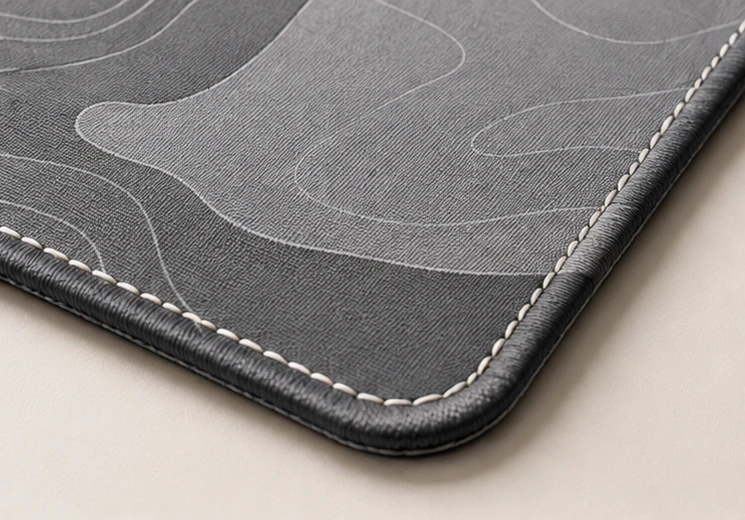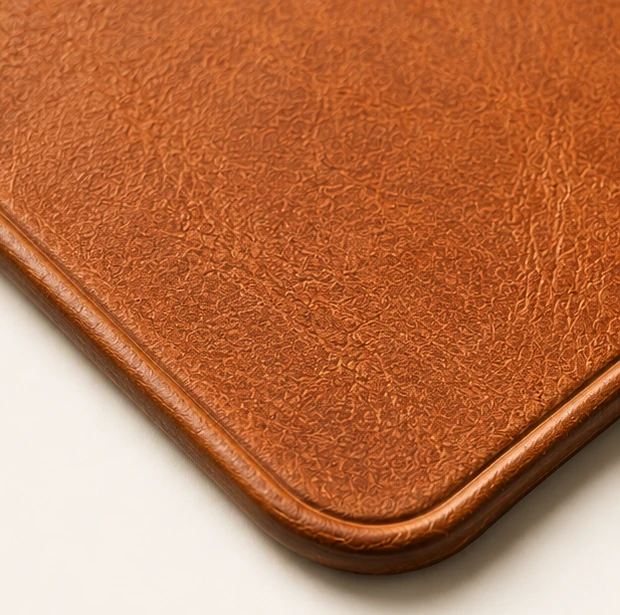
The printed surface of a desk mat will almost always outlive its edge. Fabric wears slowly and evenly under a palm; a cut edge is where the fabric meets the world, and it is where the wear concentrates. Both of our finishes are good ones. They are good in different ways, and how each eventually fails is the whole basis for choosing between them.
What the edge is actually doing
A desk mat is a printed fabric top bonded to a rubber base. Cut that laminate and you expose two raw materials at once: fabric that can fray thread by thread, and rubber that can start to separate from the fabric above it. An edge finish exists to stop both.
Stitched
A sewn border wraps the cut edge in thread, binding fabric and rubber together mechanically around the entire perimeter.
What it buys you is durability under handling. A stitched edge survives being rolled, packed, unrolled and flattened repeatedly, and it resists the specific failure that ends most mats: a corner that lifts, catches on something, and peels. In normal use a stitched border will outlast the print.
The trade-off is that you can feel it. There is a slight raised ridge, roughly a millimetre, where the thread sits. If you rest your wrists on the near edge as you type, they will cross that ridge. Most people stop registering it within a day or two; a minority never quite do.
Heat-sealed
The edge is fused rather than sewn — the materials are melted together so the perimeter closes on itself and seals flat.
What it buys you is a completely uninterrupted surface. No ridge, no thread, nothing to catch a cuff on, and a cleaner line where the mat meets the desk. On a Full Desk mat, where the front edge runs exactly where your forearms rest, that flatness is a real and daily benefit.
The trade-off is that a fused edge is less forgiving of abuse. It handles a stationary life indefinitely, but repeated rolling — especially rolling with the print facing outwards — works the seal harder than stitching. If the mat is going to travel, this is not the finish to choose.
How each one actually fails
Worth knowing, because neither failure is dramatic:
- A stitched edge fails by fraying — a thread lifts somewhere along the border, usually at a corner. It shows early and progresses slowly, so you get plenty of warning.
- A heat-sealed edge fails by separating — a short section of the seal opens, most often at a corner that has been repeatedly lifted. It shows later and progresses faster once it starts.
Neither is common in a mat that lives on one desk and gets wiped with a damp cloth. Both become likelier in a mat rolled into a tube every few weeks.
The short version
Two questions settle it.
Will the mat travel? If it goes in a bag, moves between a home desk and an office, or gets rolled away when the desk becomes a dining table — stitched. That is what stitching is for.
Do you rest your wrists on the front edge? If they sit on the mat’s near border for hours at a time and you are sensitive to texture — heat-sealed. There is nothing there to feel.
If both answers point the same way, you have your finish. If they conflict, choose stitched: the ridge is something you adapt to in two days, and the durability is something you keep for years.
A note on thickness
Edge and thickness interact, which is worth knowing if the ridge is your only hesitation. On a 5 mm cushioned mat the stitching is proportionally less noticeable, because your wrist is already stepping up half a centimetre to reach the surface. On a 3 mm low profile mat that same ridge is a much larger share of the total height and you will feel it distinctly. If you want stitched and you are worried about the ridge, going one step thicker is a genuine fix.