Every object on a desk is a small standing request for attention. Most are reasonable requests — the monitor has things to tell you, the keyboard is how you answer. The rest are requests you granted once, months ago, and have been quietly paying for ever since.
The useful question about a desk is not what to add. It is what has earned its place.
Attention is the budget, not space
Desk advice usually optimises for space, which is the wrong resource. Space is cheap; most people have more desk than they use. What is scarce is the attention available for the actual work, and every object in your peripheral vision takes a small, continuous cut of it.
It is not that a decorative object breaks your concentration outright. It is that the eye keeps checking. You look up from a paragraph and your gaze lands somewhere — and if where it lands is interesting, the trip back takes longer.
Reset, do not tidy
Tidying is sorting what is already there. It turns a cluttered desk into a neat cluttered desk, and it is why the same eleven objects survive tidy after tidy for years.
A reset is a different operation, and it is the only one that survives a busy fortnight:
- Take everything off the desk. Everything — not into piles at the corner, but off the surface entirely, onto the floor or a chair.
- Wipe the surface down.
- Put back only what you used this week. Not what you might use. What you actually picked up.
- Leave the rest where it is for one more week. Anything you get up and fetch has earned its place back; anything you never fetch, put away for good.
It takes about four minutes, and it works because it inverts the default question. Tidying asks “does this need to go?”, and the answer is always “not yet”. A reset asks “does this need to come back?”, which is a question an object has to actually earn.
Boring is not empty
A boring desk is not a bare one. The bare-desk photograph — one laptop, one plant, one cup of black coffee on an oak plank — is a set, not a workspace. Nobody works there.
Boring means nothing on the desk competes with the work. A notebook you write in every day belongs on a boring desk. Three notebooks you might write in do not. The distinction is use, not quantity, and it is why two people’s boring desks can look nothing alike.
The surface is the largest object on it
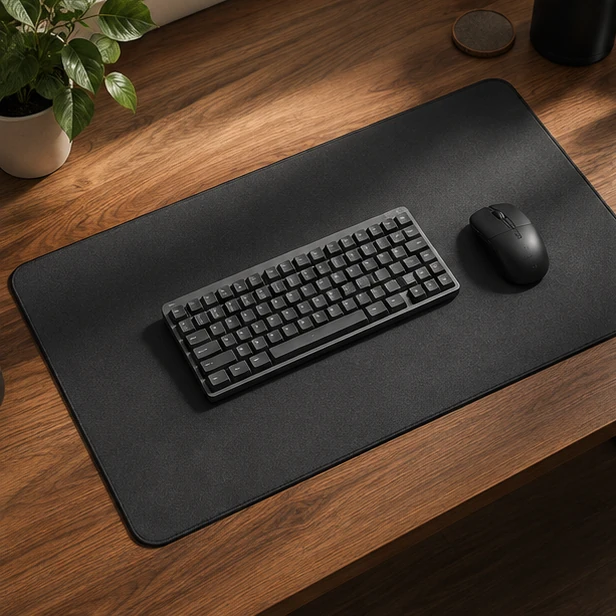
It is easy to audit the small things and never question the biggest one. The mat is the largest single visual element on most desks — larger than the monitor, from a seated angle — and it sits in your lower vision all day.
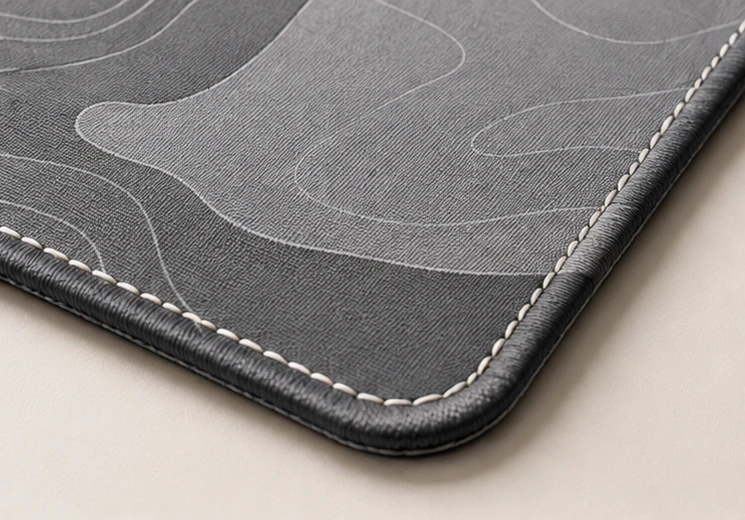
This is where the boring-desk argument becomes a design argument. A large single-texture surface gives the eye nothing to catch on, which is exactly what you want beneath a keyboard. A busy printed one offers a dozen small destinations, and it never stops offering them.
That does not mean plain black. A fine texture, a contour field, a single muted colour — all boring in the useful sense: detailed enough to be worth having, structured enough to have no focal point.
Give it a fortnight
A newly reset desk feels wrong for a few days. Sparse, faintly clinical, as though something is missing. That feeling is not information about the desk; it is your eye missing the things it had learned to check.
Two weeks in, the desk stops registering at all — which is the goal. You will know it worked when you sit down, notice nothing whatsoever, and start working.