The most common sizing mistake is buying for the desk instead of for the reach. A desk mat is not a tablecloth; it does not need to relate to the furniture at all. It needs to cover the area your hands actually move through, plus a margin, and stop there.
Here is what each of the five sizes is genuinely for.
Small — 300 × 250 mm
A mouse surface, and nothing more. It is the right answer beside a laptop on a small or shared desk, in a bag for working away from home, or on a desk where paperwork wins the argument most days and the mat has to give ground.
Do not buy Small expecting help with wrist comfort at the keyboard — it will not be under the keyboard.
Medium — 450 × 400 mm
Nearly square, which makes it the odd one out and the most misunderstood of the five. The unusual depth means it can sit under a laptop entirely, or work as a generous mouse area with real wrist support along the near edge.
It is also the size for a desk you share with something else — a keyboard tray, a sketchbook, a second person.
Large — 700 × 300 mm
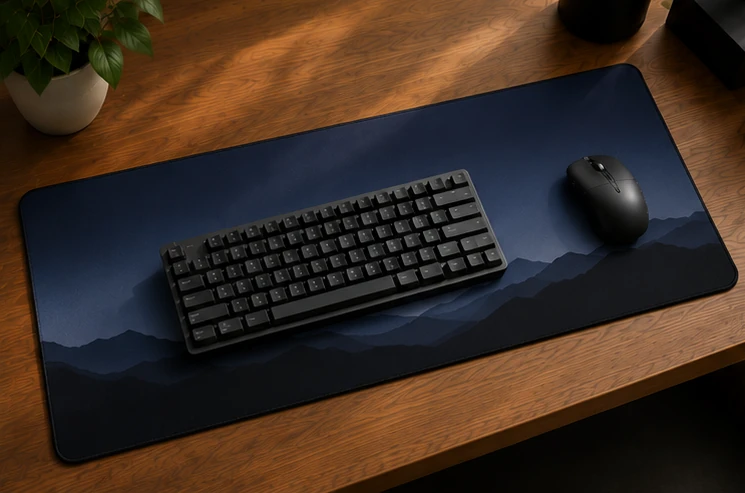
The first size that holds a keyboard and a mouse together: a tenkeyless board plus roughly 30 cm of tracking space, or a full-size board with tighter mouse room.
The 300 mm depth is the constraint to think about. It supports the wrists in front of the board, but there is little spare behind it. On a desk where the monitor sits well back, that is fine. On one where the monitor foot is close, the mat and the foot end up fighting for the same centimetres.
Extended — 900 × 400 mm
This is the size most people should buy, and if you would rather not measure anything at all, this is the safe answer.
900 mm holds a full-size keyboard with about 40 cm of clean tracking to its right — enough for low-sensitivity play — and 400 mm of depth gives a proper band of support in front of the board, with room behind it for a phone, a notebook, or the mug that has to go somewhere.
It also fits almost everything. On a 120 cm desk it leaves a deliberate margin at each side. On a 140 cm desk it reads as a defined working zone rather than a mat that failed to reach the ends.
Full Desk — 1200 × 600 mm
The whole worktop, edge to edge, on a standard 120 cm desk. Everything you own sits on one continuous surface and the desk becomes a frame around it.
It is the most transformative size and the only one that looks wrong if you get it wrong. Measure first, then measure again. A Full Desk mat on a desk narrower than 120 cm has nowhere to go: it will not tuck and it cannot be trimmed, and the overhang at the front edge will curl. If your usable width is under about 122 cm, buy Extended and be happier.
One further consideration. A mat this size covers the desk completely, so the desk’s own colour stops mattering and the mat’s becomes the room’s. That is a strong argument for choosing something quiet.
The two mistakes worth naming
Buying for the desk
“My desk is 160 cm, so I want the biggest mat” is the wrong chain of reasoning. The biggest mat is 1200 mm; on a 160 cm desk it sits centred with 20 cm of bare desk either side, which looks perfectly good — but you chose it for a reason that did not apply. Choose for reach and the size falls out of the numbers on its own.
Buying for the keyboard you plan to own
Boards get swapped far more often than mats do, and almost always for something smaller. Buying Extended because you might one day move to a full-size layout is sound planning. Buying Large because you might move to a 60% is planning for a desk with less on it than the one you have.
Still unsure
Take the four measurements first — five minutes, and it removes the guesswork entirely. If you take none of them, buy Extended. It is the size that is wrong least often.